









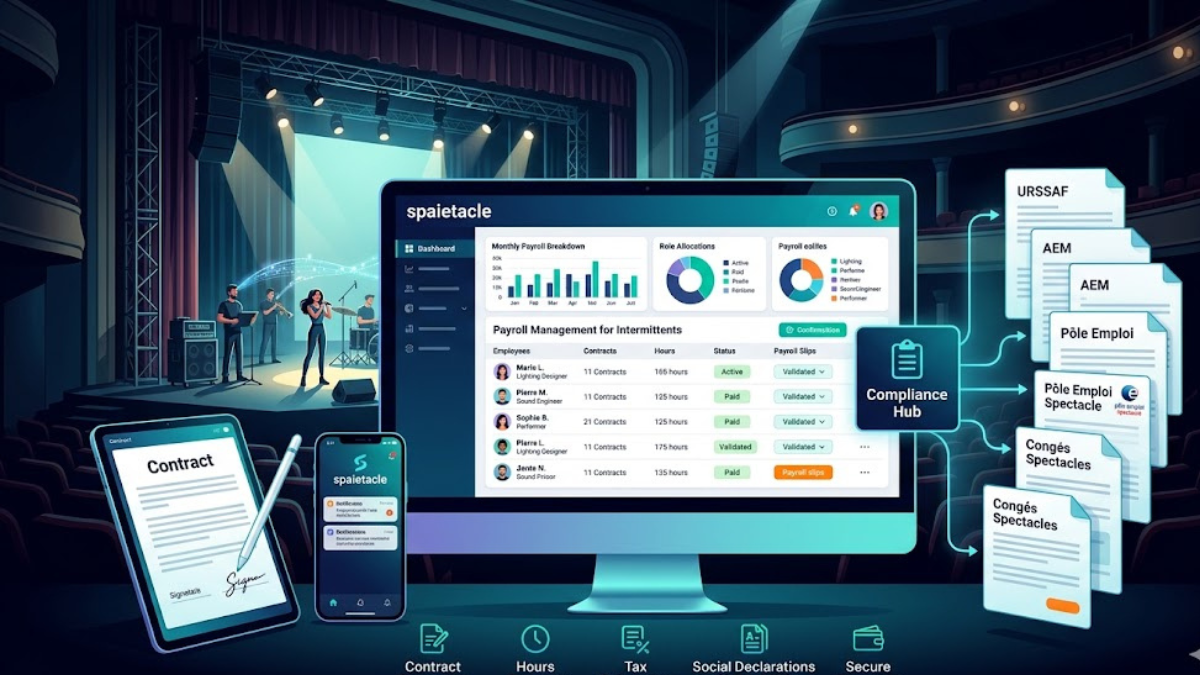
The entertainment, performing arts, and audiovisual industries are celebrated for their creativity, energy, and cultural impact. However, behind the glamour of theater stages, concert halls, and film sets lies a highly complex administrative back-office. In countries with sophisticated labor frameworks like France, managing payroll for creative professionals is notoriously difficult. This complexity stems primarily from the unique employment status of short-term contract workers, commonly referred to as “intermittents du spectacle.”
also read:https://schedows.com/cnlawblog/
To navigate these regulatory waters, cultural organizations require specialized administrative tools. Among these, spaietacle has emerged as the industry-standard software solution. Developed by the software company GHS, this dedicated payroll tool is built specifically to address the intricate demands of the cultural and audiovisual sectors. In this ultimate guide, we will explore everything you need to know about utilizing spaietacle to streamline your payroll, maintain compliance, and optimize your administrative workflows.
What is spaietacle and Who is It For?
At its core, spaietacle is a specialized payroll and social management software designed exclusively for organizations operating in the performing arts (spectacle vivant), cinema, television, radio, and broader cultural industries. Unlike general-purpose accounting or HR platforms, it is tailored from the ground up to understand the specific legal, tax, and social contribution rules governing cultural workers.
The Targeted Audience
The platform is designed for a wide range of organizations, including:
- Theater companies and drama schools
- Concert venues, music festivals, and booking agencies
- Film, television, and commercial production companies
- Audiovisual technical service providers
- Cultural associations and municipal cultural departments
By focusing on this specific niche, the software helps administrative teams transition away from complex, manual spreadsheets and generic payroll systems that fail to capture the realities of the creative workforce.
The Challenge of the “Intermittent” Status
In the French cultural sector, hiring practices are highly dynamic. Employers frequently hire artists, musicians, technicians, and stagehands on short-term contracts known as CDD d’usage (customary fixed-term contracts). These individuals, known as intermittents du spectacle, alternate between periods of employment and unemployment, often working for multiple employers in a single month.
Managing their pay requires calculating unique social contributions, tracking hours or daily shifts (cachets), and reporting data to multiple specific institutions like France Travail Spectacle, Audiens (pension and welfare), and Congés Spectacles (paid leave). Because standard HR software cannot handle these highly specialized rules natively, utilizing spaietacle becomes an operational necessity for cultural employers.
Key Features That Make spaietacle Indispensable
The strength of spaietacle lies in its deep integration of sector-specific rules. It automates tasks that would otherwise require hours of manual calculations and verified legal research.
1. Seamless Contract and Professional Profile Management
Before a single euro is paid, an employer must establish a clear employment contract. The software allows administrators to create detailed digital profiles for both permanent employees and intermittent staff. It stores critical civil status data, social security numbers, banking details, and specific professional classifications. Users can quickly generate employment contracts by applying pre-configured templates matching various collective bargaining agreements.
2. Intelligent, Automated Payroll Calculations
Calculating the net pay for an intermittent artist involves much more than applying a standard tax rate to gross hours. The software automatically handles:
- Cachets calculations: Correctly processing flat-rate payments for rehearsals or performances.
- Specific professional deductions: Applying regulatory tax deductions (abattements pour frais professionnels) based on job categories.
- Complex social contributions: Adjusting contribution rates based on ceiling limits, specific brackets, and the exact collective agreement applicable to the organization.
3. Automated Declarations and Regulatory Filings
In modern HR administration, reporting data to state authorities is just as important as paying the employees. The software simplifies this by providing direct, automated generation of essential regulatory declarations:
- DPAE (Déclaration Préalable à l’Embauche): Notifying social security before an employee starts working.
- DSN (Déclaration Sociale Nominative): Automatically generating the monthly unified social declaration file to transmit social data and payments securely.
4. Generation of Industry-Specific Documents
When a contract ends, intermittent workers rely on specific certificates to claim their unemployment benefits and paid leave. This platform allows administrators to generate these documents in just a few clicks:
- AEM (Attestation d’Employeur Mensuelle): The crucial document submitted to France Travail so that intermittent workers can calculate their unemployment rights.
- Certificats Congés Spectacles: Official certificates proving the hours worked, which are submitted to the Congés Spectacles institution to secure paid leave payouts for the workers.
spaietacle vs. Standard Payroll Software
To understand why so many cultural organizations choose this dedicated solution over mainstream options, it is helpful to compare their capabilities across several key operational areas.
| Feature / Criteria | Standard Payroll Software | spaietacle |
|---|---|---|
| Primary Focus | General businesses (retail, corporate, manufacturing) | Performing arts, cultural venues, and audiovisual production |
| Intermittent Worker Support | Extremely limited; requires complex, manual workarounds | Native calculation of cachets, specialized caps, and specific tax rules |
| Industry Certificates | Generates standard salary slips only | Automatically generates AEMs and Congés Spectacles certificates |
| Collective Agreements | Covers general national agreements | Built-in templates for dozens of specific entertainment collective agreements |
| Regulatory Updates | Periodic; focus is on broad national labor law shifts | Rapid, targeted updates reflecting immediate changes in cultural labor laws |
| Scheduling Software Integration | Typically integrates with general time-tracking tools | Smooth integration with specialized arts planning tools (e.g., Orfeo, DIESE) |
Strategic Benefits of Implementing spaietacle
Adopting spaietacle inside an organization is not merely an IT upgrade; it is a strategic business decision that brings measurable benefits to the entire team.
Mitigation of Legal and Compliance Risks
The cultural sector in France is heavily scrutinized by labor inspectors and social security organizations (URSSAF). A single calculation error on an intermittent worker’s pay slip can result in costly penalties, labor disputes, or audits. Because the software is constantly updated to reflect the latest legal texts and collective agreements, it acts as an administrative shield, ensuring that every calculation and declaration remains strictly compliant.
Massive Time and Resource Savings
Managing payroll manually for fifty intermittent technicians working on a three-day festival is an administrative nightmare. By utilizing automated templates, batch payroll processing, and direct electronic submissions, a task that would take days can be accomplished in a matter of hours. This allows administrative staff to focus on strategic tasks like budgeting, grant writing, and artist relations.
Eliminating Double Data Entry
For many cultural venues, scheduling is managed in specialized planning software. Double-entering this scheduling data into a separate payroll system is slow and error-prone. Because spaietacle features an open architecture, it can easily interface with popular planning modules. The scheduled shifts, hours, and roles of technicians or artists can be exported directly into the payroll software, creating contracts and pay slips instantly.
How to Get Started and Master the Software
While the software is incredibly powerful, its depth means that proper onboarding is essential to unlock its full potential.
[Software Installation/Cloud Setup] ➔ [Configuration of Collective Agreements] ➔ [Staff Training] ➔ [First Payroll Run & Validation]
To ensure a smooth transition, organizations typically follow these steps:
- Professional Assessment: Analyze your specific collective agreements, common contract types, and current software tools.
- Structured Training: GHS offers comprehensive training programs, such as their popular “Prise en main” (Getting Started) course. These courses cover everything from system settings to generating DSN declarations.
- Data Migration: Carefully import existing employee profiles, active contracts, and historical payroll data to ensure continuity.
- Ongoing Maintenance: Keep the software updated to the latest version to ensure you are always working with the most current tax brackets and social contribution rates.
Frequently Asked Questions
Here are ten highly useful questions and answers to help you better understand the technicalities, accessibility, and unique features of the platform.
1. Can spaietacle be run on macOS, or is it strictly limited to Windows?
Yes, the software is fully compatible with both Windows and macOS operating systems. GHS develops native clients for both platforms, allowing team members on different operating systems to collaborate seamlessly on the same database.
2. Is there a cloud-based or SaaS version of the software available?
While traditionally installed on local machines, GHS offers modern hosting solutions (such as hosted databases or cloud-based setups) that allow administrators to access their payroll data securely from any location with an internet connection, facilitating remote work.
3. What is the “ALT” key shortcut maintenance mode in the client application?
If you encounter a local connection issue or need to force a local resource refresh, you can double-click the client shortcut on your desktop while holding down the ALT key. This opens a configuration menu where you can force local updates and modify server settings.
4. Does the software support electronic signatures for employment contracts?
Yes. Through integrations with secure e-signature partners, you can generate employment contracts in the software and send them directly to artists or technicians for digital signing. This accelerates the onboarding process for short-term hires.
5. How are regulatory changes and new social contribution rates updated in the system?
GHS regularly releases software updates. When national collective agreements or social contribution rates change, users receive notifications within the application. Installing these updates instantly configures the new legal rates across your active dossiers.
6. Can an accounting firm or independent payroll manager use this tool for multiple clients?
Absolutely. The software is built with multi-dossier capabilities. This allows accounting professionals, payroll bureaus, and freelance administrative managers to maintain completely separate databases, settings, and declarations for multiple distinct client companies within a single interface.
7. How does the system handle mutual health insurance (mutuelle) for intermittent workers?
Intermittent workers have specific health insurance schemes (such as the Audiens mutuelle). The software features automated modules to calculate these specific contributions correctly and generates the mandatory declarations required by the health insurance providers.
8. Is it possible to import data from third-party scheduling tools like Orfeo or DIESE?
Yes. Thanks to dedicated APIs and file export-import formats, you can easily link your planning and scheduling software to your payroll tool. This eliminates double-entry by automatically turning planned shifts into payroll-ready contracts.
9. What options are available for backing up critical payroll data?
The software includes built-in backup tools that allow administrators to save compressed copies of their databases locally, on external drives, or onto secure cloud servers. Regular backups are highly encouraged before performing monthly closures or major software updates.
10. Does spaietacle manage payroll for permanent, non-artistic staff as well?
Yes. While it is highly famous for its specialized intermittent worker management, it perfectly handles standard permanent contracts (such as CDI or classic CDD). This allows cultural organizations to manage their entire workforce—from office administrators to touring artists—within a single, unified database.
Conclusion
Managing payroll within the cultural and entertainment sectors presents unique hurdles that standard, general-purpose software simply cannot solve. By utilizing spaietacle, organizations gain access to a highly specialized tool designed specifically to navigate the complexities of intermittent contracts, specific French social security requirements, and intricate collective bargaining agreements.
Through automated contract creation, precise payroll calculations, and instant generation of mandatory industry certificates like AEMs and Congés Spectacles documents, this platform significantly reduces administrative burdens. Investing in proper software training and keeping the platform updated ensures that your organization remains secure, compliant, and operationally efficient. Ultimately, it allows your team to spend less time on tedious paperwork and more time supporting the creative endeavors that make your organization thrive.


