









Discover the latest breakthroughs in quantum computing 2024. Learn how error correction, logical qubits, and new hardware are reshaping technology.
For years, quantum computing felt like a beautiful mathematical theory that was permanently stuck ten years in the future. We were promised machines capable of simulating complex molecules, cracking modern encryption, and optimizing global supply chains in minutes. However, the reality inside the labs was far messier. Real-world quantum systems were plagued by extreme sensitivity to environmental noise, causing fragile quantum bits (qubits) to lose their data almost instantly.
The year 2024 changed everything. Instead of simply chasing higher raw qubit numbers, the world’s leading research labs and tech giants completely shifted their focus toward stability, fidelity, and scalability. This historic transition means we are finally leaving the era of experimental prototypes and entering the age of practical, reliable systems. By diving into the latest breakthroughs in quantum computing 2024, we can see exactly how scientists have begun to tame the chaotic quantum realm.
The War on Noise: Breakthroughs in Quantum Error Correction
To understand why the progress made in 2024 is so historic, it helps to understand the fundamental roadblock that has stalled quantum computing for three decades: decoherence. Classical computers use standard binary bits (0s and 1s) that are highly stable. Quantum computers rely on qubits, which utilize the principles of superposition (existing as both 0 and 1 simultaneously) and entanglement. Unfortunately, these states are incredibly delicate. Minor temperature swings, electromagnetic fields, or microscopic vibrations cause qubits to misbehave and corrupt calculations.
Because of a law known as the no-cloning theorem, scientists cannot simply back up quantum data by copying it. Instead, they must use quantum error correction (QEC). This technique spreads the information of a single, highly stable logical qubit across a vast array of noisy physical qubits. Until recently, adding more physical qubits actually introduced more noise than it solved. The major milestone of 2024 was finally pushing past this mathematical tipping point.


Google Willow and the Tipping Point
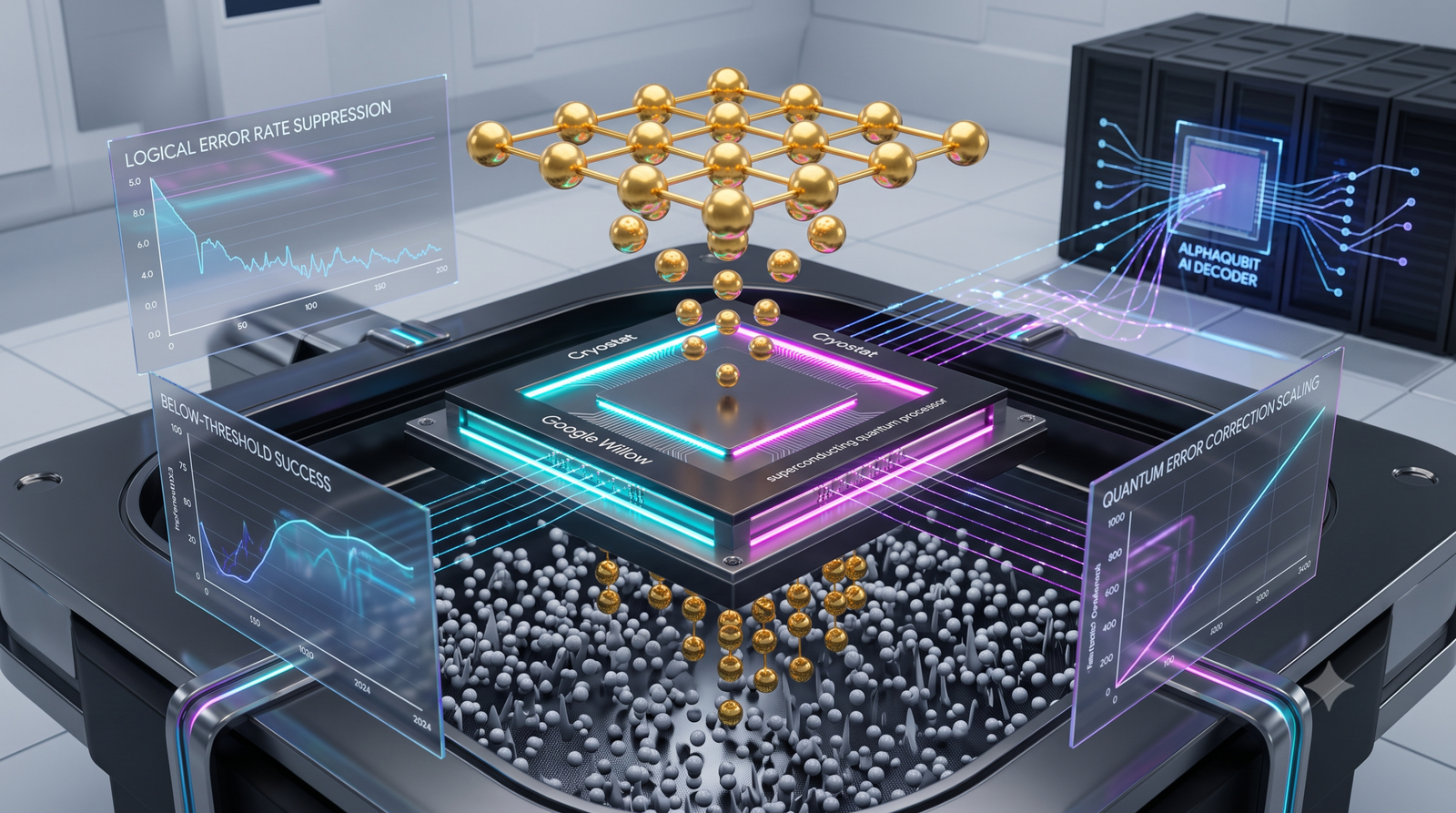
In late 2024, Google Quantum AI unveiled its Willow processor, a 105-qubit superconducting quantum chip that achieved a historic milestone. For the first time in an experimental setting, Google demonstrated that increasing the size of an error-correcting code exponentially suppresses the logical error rate. By testing grids of physical qubits at various scales, the Willow chip proved that the hardware could correct errors faster than new ones could form. This successfully demonstrated a long-sought phenomenon known as below-threshold quantum error correction.
Harvard, MIT, and QuEra’s 48 Logical Qubits
Simultaneously, a powerhouse collaboration between Harvard University, MIT, and QuEra Computing made waves by building a neutral-atom quantum processor that successfully executed algorithms across 48 logical qubits. Rather than keeping the qubits fixed in place, this system used laser-based “optical tweezers” to physically move groups of atoms around the processor mid-computation. This dynamic routing allowed the logical qubits to interact with one another while continuously correcting errors in real time.
Diversifying the Hardware Race in 2024
The latest breakthroughs in quantum computing 2024 proved that there is no single “correct” way to build a quantum computer. Different hardware architectures made monumental evolutionary leaps, turning the quantum landscape into a highly competitive, multi-path race.
| Architecture Type | Primary Mechanism | Key 2024 Milestone | Main Advantage |
| Superconducting | Tiny electronic circuits cooled near absolute zero | Google Willow chip achieved below-threshold error scaling | Incredibly fast operation and gate speeds |
| Neutral-Atom | Neutral atoms trapped and manipulated by lasers | QuEra and Harvard operated 48 dynamic logical qubits | High connectivity; qubits can be moved physically |
| Trapped-Ion | Electrically charged atoms suspended in magnetic fields | Quantinuum H2 system executed 14,000 error-free operations | Exceptionally high precision and gate fidelity |
Trapped-Ion Systems Achieve Unprecedented Fidelity
While superconducting chips run at lightning-fast speeds, trapped-ion systems took the crown for raw computational accuracy in 2024. Quantinuum’s H2 processor achieved an astonishing run of 14,000 consecutive, error-free operations. By utilizing advanced post-selection filtering techniques, researchers boosted the effective fidelity of their system by up to 800 times. Because trapped-ion qubits are inherently more stable than engineered circuits, they require far fewer physical qubits to create a reliable logical qubit, carving out a highly efficient path toward commercialization.

AI Meets Quantum: AlphaQubit Destroys the Scaling Bottleneck
Detecting an error in a quantum system is only half the battle; the system must also decode that error data fast enough to correct it before the entire calculation collapses. As quantum processors grow to include thousands of physical qubits, the classical computers tasked with decoding the error logs become completely overwhelmed by the sheer volume of data.
To solve this scaling bottleneck, Google DeepMind and Google Quantum AI co-developed AlphaQubit in late 2024. AlphaQubit is a highly specialized AI decoder built on the Transformer architecture—the same underlying technology that powers modern large language models.
By analyzing the complex, noisy consistency checks inside a quantum processor, AlphaQubit can predict whether a logical qubit has experienced an error with unprecedented accuracy.
In rigorous tests on live data from the Sycamore processor, AlphaQubit made 30% fewer errors than traditional algorithmic decoders. Furthermore, when tested on massive simulated systems containing up to 241 qubits, the AI maintained its superior accuracy. This brilliant merger of machine learning and quantum physics ensures that our classical infrastructure can keep up with the explosive growth of quantum hardware.
Real-World Applications Step into the Spotlight
Thanks to the rapid stabilization of hardware, the latest breakthroughs in quantum computing 2024 allowed industries to move away from abstract toy problems and start exploring practical, real-world applications.
Quantum Chemistry and Advanced Materials
One of the most immediate beneficiaries of 2024’s hardware stability was materials science. Microsoft integrated advanced quantum-inspired tools directly into its Azure Quantum Elements platform. By pairing high-performance classical computing with early quantum methodologies, scientists successfully screened more than a million complex chemical reaction networks. This hybrid approach allowed researchers to calculate molecular binding forces and electronic energy states with an accuracy that was previously impossible, paving the way for the development of next-generation batteries and more efficient green fertilizers.
Post-Quantum Cryptography and Blockchain Security
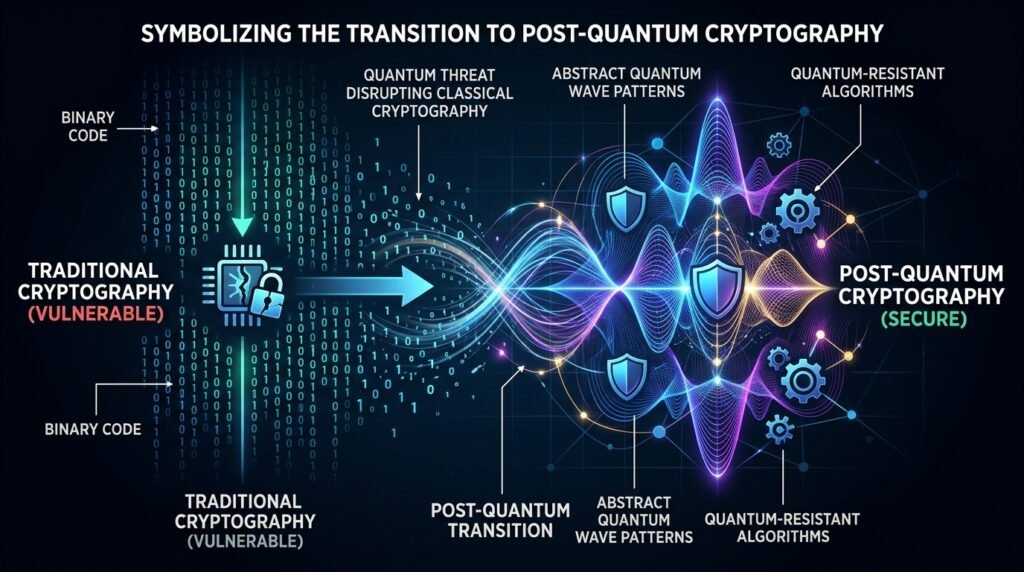
As quantum computers grow more powerful, they pose a structural threat to traditional mathematical encryption methods. The year 2024 saw a massive, proactive push to secure digital infrastructure before full fault-tolerant machines arrive. For example, StarkWare outlined a definitive post-quantum cryptographic roadmap to safeguard decentralized blockchain architectures like Starknet. By integrating natively quantum-resistant STARK proof systems, developers are ensuring that modern financial networks will remain completely secure against future quantum decryption attacks.
Frequently Asked Questions
What is the difference between a physical qubit and a logical qubit?
A physical qubit is the actual, raw hardware component on a chip (such as a single superconducting loop or an atom) that is prone to environmental noise and calculation errors. A logical qubit is a stable, virtual qubit created by grouping many physical qubits together. The physical qubits work in unison to detect and cancel out noise, allowing the logical qubit to perform error-free calculations.
Will the latest breakthroughs in quantum computing 2024 make my home computer obsolete?
No. Quantum computers are not designed to replace consumer PCs, smartphones, or gaming consoles. They excel at incredibly specific, highly complex mathematical problems—like simulating molecular chemistry, optimizing massive logistics networks, or factoring gigantic numbers. For standard tasks like browsing the web, running software, or streaming video, classical binary computers will always be faster and more cost-effective.
What role does artificial intelligence play in quantum computing?
AI acts as a critical optimization tool for quantum development. In 2024, advanced AI systems like AlphaQubit were deployed as “decoders” to rapidly identify and diagnose errors within fragile quantum hardware. Additionally, machine learning algorithms are used to optimize quantum circuit designs and manage the hybrid workflows that combine classical supercomputers with quantum coprocessors.
What is a photonic quantum computer?
A photonic quantum computer uses particles of light (photons) instead of physical matter like atoms or circuits to process information. The primary breakthrough for photonics in 2024 involved new architectures designed to mitigate photon loss, which has historically been a massive roadblock for light-based systems. Photonic systems are highly appealing because they can operate at room temperature and integrate naturally with fiber-optic communication networks.
How close are we to a commercially viable quantum computer?
While fully fault-tolerant quantum computers capable of breaking modern encryption are still several years away, 2024 dramatically accelerated the timeline. The industry is currently moving into a highly productive hybrid era. Over the next few years, businesses will increasingly access mid-sized, error-corrected quantum co-processors via cloud networks to optimize logistics, financial portfolios, and pharmaceutical research.
Conclusion
The year 2024 will go down in history as the definitive turning point when quantum computing transformed from a fragile laboratory experiment into an engineered reality. By successfully demonstrating below-threshold error correction, pioneers like Google and Quantinuum proved that the structural hurdles facing quantum processors are entirely solvable. Combined with the analytical power of AI decoders and the rapid evolution of diverse hardware architectures, the latest breakthroughs in quantum computing 2024 have laid down a rock-solid foundation for the next technological revolution. We are no longer wondering if a useful quantum computer can be built—we are actively watching it happen.


