









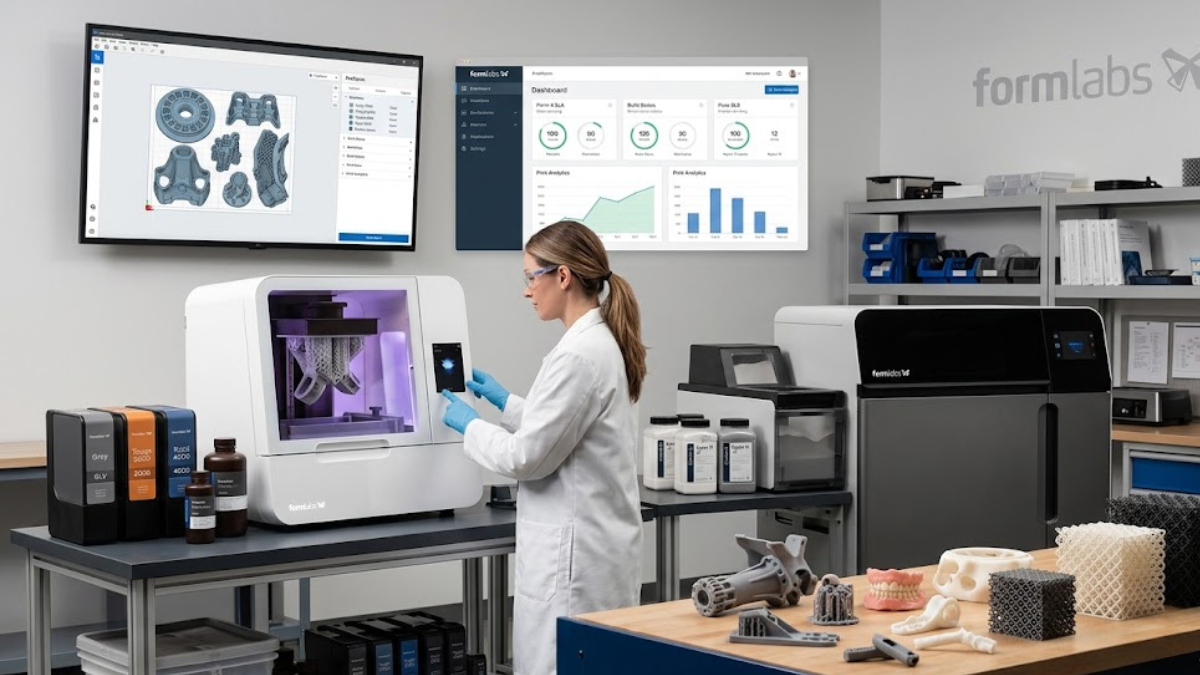
The landscape of professional 3D printing has experienced a seismic shift over the past decade. What once required massive, industrial-sized rooms and six-figure budgets is now readily available right on a desktop or workshop workbench. At the absolute forefront of this democratization is Formlabs, a company that fundamentally redefined professional stereolithography (SLA) and selective laser sintering (SLS) systems.
also read: https://schedows.com/myolsd/
By prioritizing crisp surface finishes, high dimensional accuracy, and remarkably streamlined end-to-end workflows, the Formlabs ecosystem has seamlessly transitioned from standard rapid prototyping into true end-use manufacturing. Whether you are an industrial design engineer checking tolerances, a dental technician creating orthodontic aligners, or a surgeon prepping for a complex procedure, understanding the capabilities of these hardware ecosystems is vital to maximizing hardware efficiency.
1. Demystifying Formlabs 3D Printing Technology
To understand why these systems are highly regarded in professional spaces, it is essential to explore the underlying engines driving them. For years, traditional SLA printers relied on inverted laser steering setups where a laser beam bounced off dynamic galvanometers to trace out a cross-section.
Formlabs advanced this concept with its proprietary Low Force Display (LFD) and Low Force Stereolithography (LFS) print engines. This approach utilizes a flexible-bottom resin tank that radically reduces the physical peeling forces exerted on parts during the printing process naturally. Because the forces are significantly lower, the machine can print with much lighter support structures, resulting in flawless surface finishes that naturally require minimal post-processing as well!
The Powerhouse Engine Components
- The Light Processing Unit (LPU): A modular optical engine delivering a highly collimated, uniform light path. This guarantees that whether a part sits perfectly in the center of the build platform or out at the far margins, it cures with uniform accuracy.
- Flexible Film Resin Tanks: Unlike rigid, clouding-prone PDMS vats of the past, modern flexible tanks allow for immediate part release without heavy vertical tearing stresses.
- Integrated Sensing Systems: Upgraded internal sensors continuously monitor resin levels, temperature profiles, and peel forces to auto-correct anomalies before a failure can occur.
2. Desktop SLA Pioneers: Form 4 and Beyond
The introduction of the Formlabs Form 4 generation marked a monumental leap forward by shifting to ultra-fast Masked Stereolithography (MSLA). By blending an ultra-high-power LED array backlight unit with a custom liquid crystal display mask, the machine cures an entire layer of photopolymer resin simultaneously, regardless of how many individual pieces are grouped together on the build platform.
Form 4 and Form 4B Architecture Comparison
To see how these setups stack up for varied commercial workflows, let us review the exact technical specifications of these standard desktop units.
| Feature / Metric | Form 4 Standard | Form 4B (Medical & Dental) |
| Primary Technology | Masked Stereolithography (MSLA) | Biocompatible Masked SLA |
| Build Volume (W x D x H) | $20.0 \times 12.5 \times 21.0 \text{ cm}$ | $20.0 \times 12.5 \times 21.0 \text{ cm}$ |
| XY Pixel Resolution | 50 microns ($\mu\text{m}$) | 50 microns ($\mu\text{m}$) |
| Maximum Print Speed | $100 \text{ mm/hour}$ | $100 \text{ mm/hour}$ |
| Material Licensing | Standard & Open Material Mode | Biocompatible, Dental, & Open |
| Target Industries | Engineering, Aerospace, Product Design | Hospitals, Dental Labs, Biotech |
The specialized Form 4B is intentionally configured to handle strict, certified medical and dental resins. This enables the fabrication of autoclavable surgical guides, biocompatible provisional restorations, and diagnostic anatomical models with absolute geometric fidelity.
3. Industrial Plastic Production: The Fuse SLS Series
While resin printing dominates fine visual detail and tight fluid seals, true mechanical strength often calls for functional thermoplastics. Formlabs successfully brought industrial powder-bed fusion out of the dedicated factory floor with its Fuse SLS line.
Selective Laser Sintering works by using a precision laser to fuse nylon powder layer by layer inside a heated chamber. The beauty of this approach is that the unsintered powder acts as continuous, natural support for the parts being built. Engineers can nest components tightly in three dimensions, optimizing the full volume without needing to clip away support scaffolding.
+-------------------------------------------------------------+
|               SLS PRINTING DIGITAL WORKFLOW                 |
+-------------------------------------------------------------+
|  1. Nest Parts in PreForm 3D Space (No Supports Needed)     |
|                             ↓                               |
|  2. Laser Sinters Nylon Powder Layer-by-Layer in Fuse Build |
|                             ↓                               |
|  3. Cool Cycle Safely Controls Polymer Crystalline Growth   |
|                             ↓                               |
|  4. Post-Process via Fuse Sift to Reclaim & Recycle Powder  |
+-------------------------------------------------------------+
With industrial-grade setups like the Fuse 1+ and Fuse X1, operations can comfortably run low-volume production batches of Nylon 11 or Nylon 12 components. These end-use parts exhibit isotropic strength—meaning they are equally strong in all $X$, $Y$, and $Z$ directions—matching the structural integrity of traditional injection molding.
4. Unrivaled Material Ecosystem Architecture
Hardware is only half the equation; a 3D printer is ultimately defined by the engineering materials it can handle. The comprehensive Formlabs library spans over forty formulation profiles designed to meet diverse physical needs naturally.
Material Categories and Real-World Applications
- General Purpose Materials: Clear, Grey, Black, and White formulations optimized for rapid look-and-feel prototyping, educational models, and fine-detail artistic conceptualization.
- Engineering Rigid Resins: Materials infused with glass or ceramic particles to offer extreme tensile modulus and heat deflection temperatures exceeding $200^\circ\text{C}$—ideal for injection mold inserts and wind tunnel fixtures.
- Tough & Durable Families: Formulations engineered to mimic the high impact resistance of ABS and the elongation-at-break metrics of Polypropylene. These are highly valued for snap-fit enclosures and rugged field enclosures.
- Flexible & Elastic Resins: Ranging from soft 50A durometer profiles up to 80A variants, these allow developers to rapidly prototype gaskets, soft-touch handles, and complex wearable devices.
5. Software Ecosystem Integration: PreForm and Dashboard
Even the most advanced hardware can fall short if the preparation software is cumbersome. This is why the cloud-managed PreForm software is engineered to act as an intuitive digital workspace. PreForm uses proprietary orientation algorithms to calculate optimal print orientation angles, analyze potential overhang errors, and calculate exact resin usage statistics.
For multi-machine operations, the browser-based Dashboard system steps in as a robust remote management hub. Managers can track ongoing print progress via live internal webcams, schedule preventative upkeep intervals, monitor consumption analytics across print fleets, and assign distinct jobs to specific print queues anywhere across a corporate network seamlessly.
6. Comprehensive Post-Processing: Automation in Cleanrooms
Stereolithography parts cannot go straight from the build platform to a functional assembly; they exit the liquid resin vat coated in uncured, sticky photopolymer. To systematically eliminate human error and chemical messy work during cleanup, automated washing and curing stations are essential pieces of infrastructure.
       [Raw 3D Printed Part]
                 │
                 ▼
 ┌───────────────────────────────┐
 │   Automated Solvent Wash     │ ◄── Removes raw residual resin
 └───────────────┬───────────────┘     via isopropyl alcohol (IPA)
                 │
                 ▼
 ┌───────────────────────────────┐
 │  Precision Radiant UV Cure    │ ◄── Cross-links polymer matrix
 └───────────────┬───────────────┘     for maximum tensile strength
                 │
                 ▼
      [Finished End-Use Part]
Using specialized units like the Form Wash and Form Cure, parts are agitated in Isopropyl Alcohol (IPA) for exact, timed intervals to clean away residual monomer without over-soaking thin features. Following the wash cycle, precision UV post-curing units bake the parts under specific thermal environments to fully cross-link the polymer chains, unlocking the final mechanical properties specified on engineering datasheets.
Frequently Asked Questions
Q1: Can I use third-party resins on a Formlabs SLA printer?
Yes. Through Open Material Mode (OMM), users can create custom printing profiles with alternative 3D resins by adjusting laser exposures, heating baselines, and layer heights.
Q2: How long does a typical flexible resin tank last before replacement?
Modern Form 4 tanks are exceptionally durable and rated to last over 75,000 cured layers with standard materials before exhibiting mechanical fatigue or optical haze.
Q3: What is the minimum wall thickness supported by these systems?
For structural safety, a minimum supported wall thickness of 200 microns ($0.2\text{ mm}$) is highly recommended to withstand peel forces without warping.
Q4: Do parts printed with SLS powder require support structures?
No. SLS technology uses the surrounding unsintered powder bed to support overhangs and islands, enabling total geometric design freedom without touchpoints.
Q5: Is it safe to operate these printers in a standard office setting?
Yes, the desktop units are engineered for standard indoor environments, featuring internal charcoal air filtration units that tightly control volatile organic compound (VOC) emissions.
Q6: What is the refresh rate for recycled nylon powder in the Fuse system?
The system can run efficiently with a fresh powder blend ratio as low as $30\%$, letting you recycle up to $70\%$ of the unsintered powder from previous runs.
Q7: How does the Z-axis force sensor maximize print speed?
The integrated sensor dynamically reads real-time pull forces. If a layer has minimal surface area, it speeds up the cycle; if a layer is large and flat, it adjusts parameters to prevent damage.
Q8: Can parts printed on the Form 4B be safely sterilized?
Yes. Biocompatible components fabricated with approved resins can be safely autoclaved, gamma-irradiated, or chemically sterilized using standard medical protocols.
Q9: What file extensions does the PreForm software accept natively?
The software processes industry-standard 3D assets natively, including STL, OBJ, and 3MF files, ensuring smooth integration with any modern CAD suite.
Q10: What is the pixel size of the Light Processing Unit on the Form 4 series?
The masked LCD screen provides a fine 50-micron pixel resolution, coupled with pre-tuned anti-aliasing to deliver ultra-smooth surfaces that easily rival injection molding.
Conclusion
The additive manufacturing solutions brought to life by Formlabs bridge the gap between initial design concepts and demanding, high-throughput manufacturing environments. By refining low-force display engines, expanding into powder-bed fusion, and automating post-processing, they have turned 3D printing into an incredibly reliable and scalable tool. Investing in these ecosystems gives businesses, researchers, and medical experts the precision and flexibility needed to bring their ideas to life smoothly, efficiently, and with absolute confidence.


