









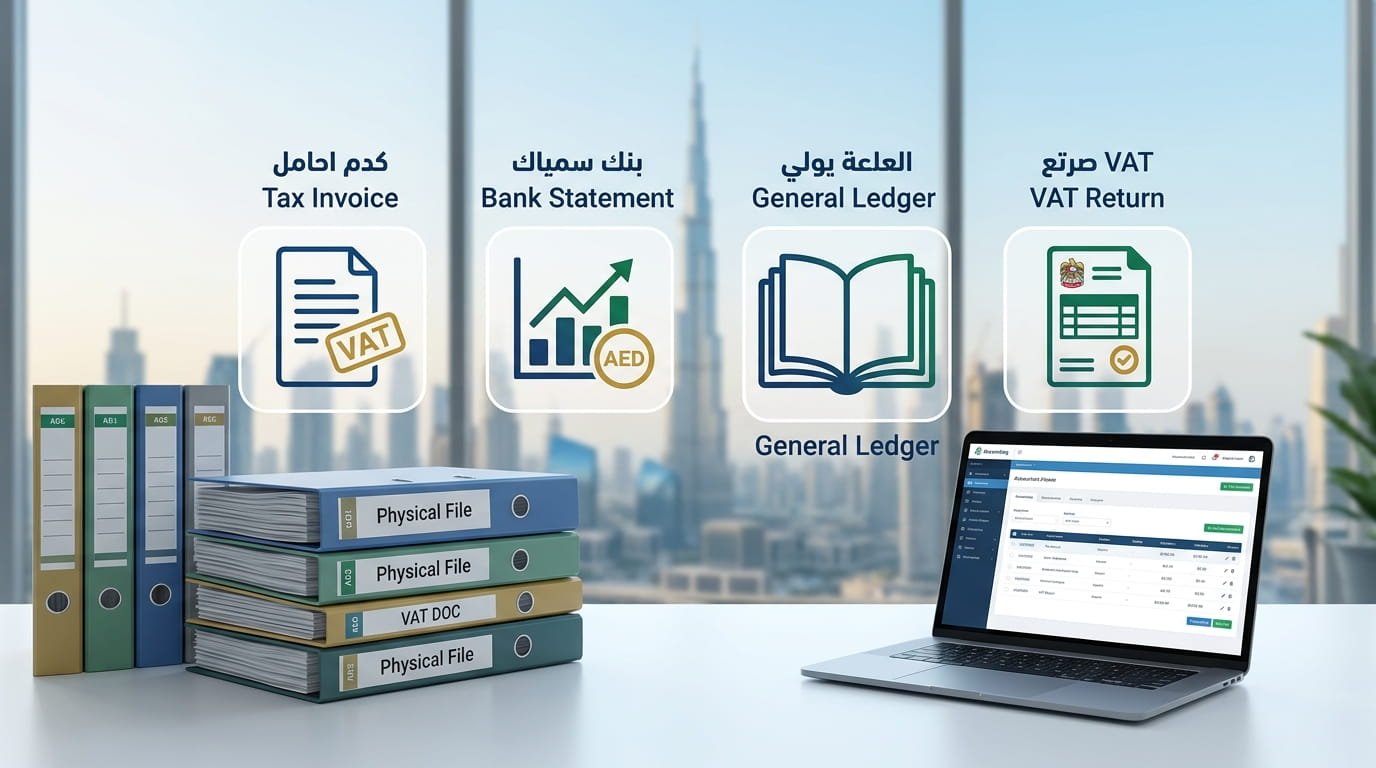
Businesses should keep two sets of accounting records: the books themselves (ledgers, journals, and financial statements) and the documents that back them up (sales and purchase invoices, receipts, bank statements, payroll files, contracts, and asset records). In the UAE, this is a legal duty, not just good practice. Corporate tax records must be kept for at least seven years and VAT records for at least five, and the Federal Tax Authority (FTA) can ask to see any of them during an audit.
That is the short answer. The rest of this guide breaks it down: exactly which documents belong in each category, how long each one must be kept, whether digital copies are enough, and what the penalties look like when records fall short. At HAGROUP, we manage the books for businesses across the UAE, and the companies that get through audits without stress are always the ones that sorted these basics out early.
Start with the two building blocks of good records
Every complete record-keeping system has two layers. The first is your books: the journals, ledgers, and financial statements that summarize what happened in the business. The second is your supporting documents: the invoices, receipts, and statements that prove each entry actually took place.
The books tell the story. The documents are the evidence. A tax authority never takes your profit figure on trust; it checks whether the numbers in your return trace back to real paperwork. If you can produce the invoice, the bank entry, and the ledger line for any transaction, your records will hold up. If any of those three is missing, you have a gap.
What accounting records should businesses keep?
Keep records in six core categories. Together they cover everything a tax audit, a bank, or a buyer of your business would ever ask to see.
- Income records. Every sales invoice you issue, plus credit notes, customer receipts, point-of-sale reports, and payment gateway statements. These prove the amount and source of your revenue and must match the deposits landing in your bank account.
- Expense records. Supplier invoices, purchase receipts, expense claims, and petty cash vouchers. A line on a bank or card statement is not enough on its own, because it shows that money left the account but not what it bought. The invoice or receipt is what makes an expense deductible.
- Bank and finance records. Statements for every business bank account and credit card, monthly reconciliations, loan agreements, and repayment schedules. These tie your books to the outside world and are the first thing an auditor checks.
- Payroll records. Employment contracts, salary registers, Wage Protection System (WPS) files, timesheets, leave records, and end-of-service benefit calculations. Payroll is usually one of the largest expenses in a business, so it needs the same paper trail as any supplier.
- Asset records. Purchase invoices for equipment, vehicles, and property, plus the cost of any improvements, depreciation schedules, and sale or disposal documents. You need these to work out depreciation each year and the gain or loss when you eventually sell the asset.
- Ownership and legal records. Your trade license, memorandum of association, shareholder registers, board resolutions, and major contracts. Under the UAE Commercial Companies Law, company registers stay on file for the life of the company, right up to liquidation.
One habit ties all six categories together: capture the document at the moment the transaction happens. A photo of a receipt attached to the expense entry the same day beats a shoebox of paper sorted at year end, every time.
What does the FTA expect for VAT and corporate tax?
The FTA expects your records to be complete enough to verify every figure in your tax returns. For VAT-registered businesses, that means keeping every tax invoice you issue and receive, all debit and credit notes, customs declarations for imports and exports, records of goods used for non-business purposes, the calculations behind your input tax claims, and copies of the VAT returns themselves. Without a valid tax invoice, you cannot reclaim the VAT paid on a purchase.
Corporate tax added a second layer of duties from June 2023. Under Article 56 of the Corporate Tax Law, every taxable person must keep all records and documents that support the figures in their return for seven years from the end of the relevant tax period. That includes financial statements, transaction records, asset and liability registers, and transfer pricing documentation where it applies. Even businesses that qualify for an exemption must keep the records that prove they qualify. The FTA’s corporate tax pages set out the full requirements, and guides on registration, filing, and record keeping are published there as they update.
The tax itself is simple to state: 0% on taxable income up to AED 375,000 and 9% above that. Your records are what prove which side of that line your income sits on.
How long should businesses keep accounting records?
Retention periods in the UAE depend on the type of record, not the size of your business. The table below covers the periods that matter most.
| Record type | Minimum retention period |
| Standard VAT records (invoices, credit notes, VAT returns) | 5 years from the end of the tax period |
| Corporate tax records and supporting documents | 7 years from the end of the tax period |
| Transfer pricing documentation | 7 years |
| Capital asset records under VAT (machinery, equipment) | 10 years |
| Real estate records | 15 years |
| Company registers, memorandum of association | Until the company is liquidated |
Two points catch businesses out. First, the clock starts at the end of the tax period, not the invoice date, so a receipt from January 2025 in a December year-end company must survive until the end of 2032 under the corporate tax rule. Second, the duty does not end when the business does. A company that closes or liquidates still has to keep its records for the full period.
Simple rule of thumb: keep everything for seven years, real estate paperwork for fifteen, and formation documents forever. Follow that and you satisfy every standard FTA requirement in one policy.
Are digital records enough?
Yes. The FTA accepts digital records, and the same rules apply to them as to paper: they must be accurate, complete, secure, and easy to retrieve in a readable format when the authority asks. In practice, cloud accounting software with documents attached to each transaction meets the standard better than filing cabinets do, because nothing fades, floods, or goes missing in an office move.
Two safeguards matter. Back everything up in at least two places, and restrict who can edit historical entries so the records stay trustworthy. With the UAE’s e-invoicing rollout beginning in 2026, invoices will increasingly be created in standardized digital form from the start, which makes a paper-first system harder to justify every year.
What happens if your records fall short?
Failing to keep the required records carries a fixed penalty of AED 10,000, rising to AED 20,000 for a repeated violation within 24 months. Those fines apply per violation, and separate penalty rules exist for VAT and corporate tax, so weak record keeping can be fined under both regimes.
The fines are only the visible cost. Missing purchase invoices mean lost input VAT claims. Undocumented expenses can be disallowed, which pushes up taxable income. And a business that cannot produce clean records during an audit invites a longer, deeper review, which costs management time even when nothing is wrong.
How to set up a record-keeping system that holds up
A system that passes an FTA audit does not need to be complicated. Six steps cover it.
1. Open a dedicated business bank account and run every business transaction through it. Mixing personal and business money is the single biggest cause of messy records.
2. Use cloud accounting software rather than spreadsheets, so every entry is dated, backed up, and traceable.
3. Attach the document to the entry the day it happens: snap the receipt, upload the invoice, link the contract.
4. Reconcile the bank every month so your books and your bank statement always agree, and differences get fixed while the memory is fresh.
5. Set a retention policy that labels each record type with its destruction date, then archive rather than delete when the year closes.
6. Review quarterly with an accountant to catch classification errors and missing documents before a filing deadline turns them into a problem.
If you would rather not build and run this in-house, HAGROUP’s FTA-registered accounting team sets up this exact system for UAE businesses, then handles the bookkeeping, VAT, and corporate tax filings that sit on top of it. General guidance on the UAE’s tax framework is also available on the official UAE government portal, which is worth bookmarking as the rules continue to develop.
Frequently asked questions
What accounting records does a small business need to keep in the UAE?
Sales and purchase invoices, receipts, bank statements, payroll files, asset records, and your ledgers and financial statements. If you are VAT-registered, add all tax invoices, credit notes, customs documents, and filed VAT returns. Formation documents like the trade license and memorandum of association stay on file permanently.
How long do I need to keep accounting records in the UAE?
At least five years for VAT records and seven years for corporate tax records, counted from the end of the relevant tax period. Capital asset records under VAT run to ten years and real estate records to fifteen. Company registers are kept until liquidation.
Are scanned or digital records accepted by the FTA?
Yes. Digital records are fully acceptable as long as they are accurate, complete, securely stored, backed up, and retrievable in a readable format on request. Cloud accounting software with documents attached to each entry meets the standard well.
Do I still need to keep records if my business made no profit or has closed?
Yes. The retention duty applies regardless of profit, and it survives closure. A liquidated company must still keep its records for the full seven-year corporate tax period, because the FTA can audit tax years in which the business was active.
What is the penalty for not keeping proper records in the UAE?
A fixed administrative penalty of AED 10,000 for the first violation and AED 20,000 for a repeat within 24 months. On top of that, missing invoices block input VAT claims and can lead to expenses being disallowed for corporate tax.
Conclusion
Keep your books plus the documents that prove them: income and expense invoices, bank statements, payroll files, asset records, and your legal formation papers. In the UAE, hold VAT records for five years, corporate tax records for seven, capital asset records for ten, and real estate records for fifteen. Capture documents digitally as transactions happen, reconcile monthly, and archive by year. Do that, and an FTA audit becomes a request you can answer in a day, not a crisis.


